

viewtopic.php?f=5&t=10839
I've been following these forums for a long time, and have been a bit shy in posting about my turtle. I'm worried about Philburt's shell due to many mistakes I've made over the years.
After the images, I've tried to answer all of the questions contributors seem to ask of the original posters before giving advice. Hopefully I'll have provided enough information
Here is Philburt

Here is a clear indication of some of the issues she has:
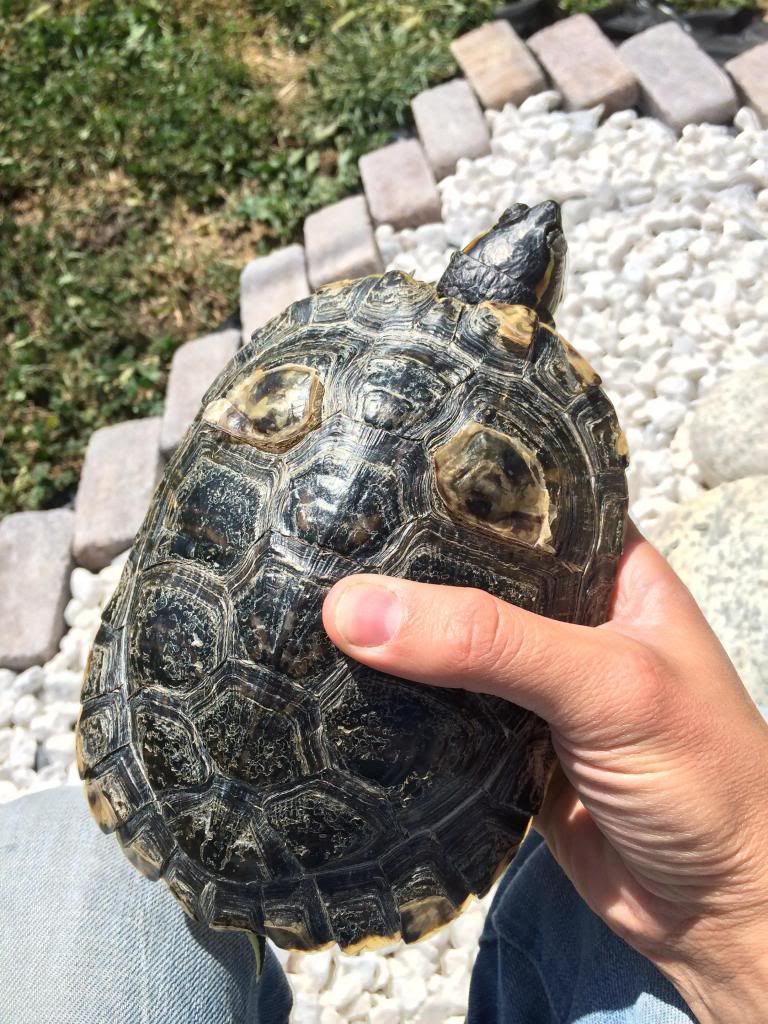

Here you can see her shell is growing curved down and maybe even in.
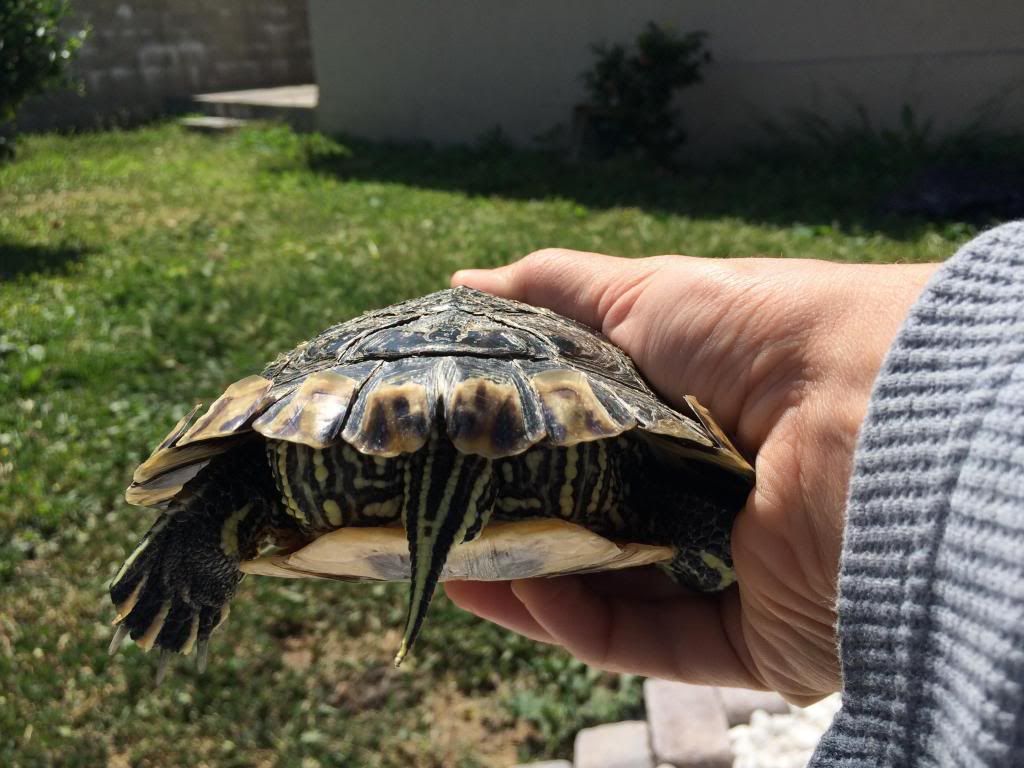
This looks to me like she's overweight.

Some history:
I adopted Philburt from my neighbors in Chicago during my college years; they'd bought her in Chinatown as a hatchling, then several days later decided they didn't want her. While I was having dinner at their house, they asked me if I wanted to watch them flush Philburt down the toilet. I begged them to let me keep her.
(FYI: Philburt is a girl. By the time I was informed enough and she was old enough for me to determine her sex, I was accustomed to calling her Phil. So Philburt she remains. I'm all for gender neutral names.)
When I got her, she was tiny, and I knew nothing of taking care of animals, let alone a turtle. I had the tiny container she came in, and I did my best to do my research and take care of her. As she grew, I failed to pay mind to how her diet should change based on her age, and continued to overfeed her. I got a lot of bad information from pet stores, especially people who mostly work with dogs and cats anyway. It's taken a long time for me to find supportive, well informed communities, and weed through a lot of misinformation.
After college, I moved to LA and have since acquired income to support both myself and proper care of Philburt. I've moved into a house with a yard, and I share with my roommates whom I've lived with for as long as I've had Philburt. We'd all like to see her have a better life.
I've posted pictures in the Outdoor Habitat forums of her new pond setup. You'll find one picture of the pond here, so you can get an idea of her current living conditions. Any information as to how to correct and treat her conditions are greatly appreciated.
SHELL ROT
I'm fairly certain she had Shell Rot a year or so ago. She was sickly, sluggish, quiet and didn't eat often. That was when I first noticed the white spots, the discolored scutes and the odd shedding. It had never occurred to me that my pet could get sick. (I know, it's absurd.) I scoured the internet and found some home remedies involving beta dine solution, with 18 hour dry-docking and consistent bathing/scrubbing. Austin's turtle page was my first real kickstarter to turtle care.
The shell has greatly improved, but I can see that I have not fixed the issue.
BEHAVIOR
She is very active, has no trouble eating, is not shy in the slightest and happily slides off her rock to come beg me for food whenever I am near.
AGE
I suspect she is around 6 years old. I would have gotten her in her first year of life, and have had her for 5-6 years.
CURRENT DIET
I feed her Monday, Wednesday, Friday--usually morning, sometimes afternoon, roughly around the same time.
Her diet consists of Reptomin Pellets, about as much as the size of her head, wrapped in green leaf/red leaf lettuce, occasionally dandelion greens. She won't often go for the greens unless she thinks there's a pellet in there, so I'll put a pellet in ever other 1 or 2 times I offer her greens. My hope is to get her adjusted to the greens for her adulthood.
She'll usually get 1-2 calcium injected crickets, usually to motivate her to eat the greens. I believe the brand is Flukers.
PREVIOUS DIET
I would mostly feed her pellets, with freeze dried mealworms and grasshoppers, nearly every day throughout her life. I wasn't considering that she was begging and would always eat, even if she didn't need it. I also figured if she wasn't eating her veggies, it meant she just didn't eat veggies...Good thing I'm learning this with a turtle and not down the line when I have kids.
VITAMINS
I have trouble finding reliable information on this. I give her a multi-vitamin powder (REP-CAL Herptivite) mixed with a calcium powder supplement (REP-CAL Calcium with VIT. D3), and I dust the pellets before feeding her.
She'll occasionally have a calcium cuddle bone floating around to gnaw on as well.
BASKING TIME
She can bask freely, as she's left outside in LA California. The morning sun will hit right around 8 AM, and remain direct until about 5ish, when my house starts to block the sunlight and shadow the pond. She's almost always basking.
WATER QUALITY
This is something I'm starting to learn.
AMMONIA seems to be hard to get rid of, and I have a slight, possibly .2 ppm. It's the lowest on my chart, but I know you're not supposed to have any ammonia at all.
NITRITE I've never detected Nitrite, which seems odd since I thought that's what gets converted to Nitrates, which I do have
NITRATE I have right around 5ppm
PH is between 8.0 and 8.4, depending on the time of the day. I've never detected higher or lower than that, be it 5:30 AM, 2:00 PM or 8:00 PM.
I've heard varying things about PH level for Philburt.
POND SIZE
Her habitat is just under 300 gallons I believe (if I've done that math correctly)
I think the inside wall is 5x7, and the average depth is 15inches.
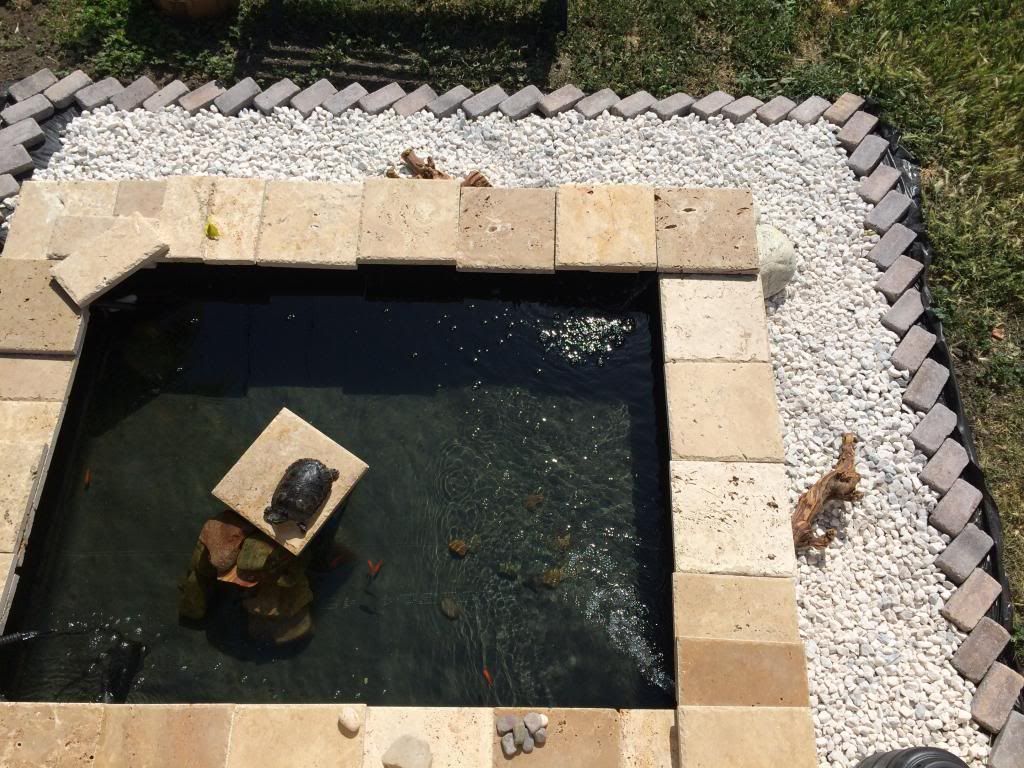
This is a link to my Pond setup, if you have questions about anything like filtration/aeration/water flow...or if you're just curious
viewtopic.php?f=7&t=35976
Please help. I've been attempting to correct a lot of problems with her living conditions for a long time. I'm also searching for a proper VET in the LA area. Thank you to everyone who continues to contribute to these forums. It's greatly impacted the way I care for Philburt, and has encouraged me to better improve her quality of life.
