Urgent Care :: 10 y/o RES needs help!! (Pink Skin/White Shell)

This is not a substitute for qualified and relevant veterinarian care.
Read this before you post a new topic here.

Post Posted: Fri Feb 22, 2008 1:36 am   10 y/o RES needs help!! (Pink Skin/White Shell)

-edit-
Last edited by c8r9x on Tue Dec 16, 2014 4:16 pm, edited 1 time in total.
c8r9x
 
Posts: 17
Joined: Jan 7, 2008

Post Posted: Fri Feb 22, 2008 2:03 am   

It sounds like the pink might be a circulation issue since it mostly resolved itself once your turtle started moving.
Here is a link to the proper equipment for a RES.

http://www.redearslider.com/startup.html
http://www.redearslider.com/index_basic_care.html

Having a good set up is a great first step to getting a turtle happy and healthy. Also read up on dietary needs and just browse the website in general. And, if you have any questions search the forum and feel free to ask.
2 RES: Leo (f) and Ezra (m)
1 Russian Tortoise: Godzilla (m)
User avatar
megcornell
Retired Mod
 
Posts: 3206
Joined: Apr 30, 2006
Location: New York, NY

Post Posted: Fri Feb 22, 2008 2:19 am   

-edit-
Last edited by c8r9x on Tue Dec 16, 2014 4:17 pm, edited 1 time in total.
c8r9x
 
Posts: 17
Joined: Jan 7, 2008

Post Posted: Fri Feb 22, 2008 10:25 am   

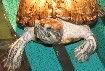
He looks fairly healthy based on the pics you provided. If the pink color disappears after a while, then it is just a circulation issue, and RES's are notorious for bad circulation (not harmful for them, that's just the way they are). Things that help the circulation: exercise & swimming in the tank. Also providing a nice warm basking bulb since it helps an RES warm up & digest their food.

I can't see the white spots all that well, but my guess is that he somehow rubbed his shell against some sharp rocks which damaged the normal "brown" layer. And from the size of him, he isn't growing anymore & their shells grow slower as they age. The important thing to do now is to always make sure you do regular water changes, make sure to provide UVB and UVA lighting (UVB = helps assimilation of calcium, and UVA = heat to help encourage him to bask). Don't just buy any lighting bulb that says the word "reptile" on it, that doesn't mean anything. Most of the bulbs out there do NOT have UVB & are only UVA bulbs. turtles require more UVB than other reptiles so it is important to get the right lighting to help the shell recover. MVB bulbs are great because they have both UVA & UVB (Powersun UV is the one I have, but there are others on the market). If you have a tank that is 75 gallon size or larger, MVB is great for this. If you have a smaller tank, then you will need to go with a separate UVB bulb, like a reptisun 5.0. Be prepared that UVB bulbs are NOT cheap and they must be replaced AT LEAST once a year because the UVB part of the bulb burns out. UVA can just be a standard house-hold bulb (100W bulbs are great for this purpose & cheap).

The white spots WILL eventually grow out but it takes time since the shell grows slowly. You may see improvement within a year of good strong UVB lighting/basking. The white spots eventually will chip off, revealing brown shell underneath. I've seen it with my own turtle so that's why I can give you this information. Good luck & post a picture of your set up once you get the lamps in place!
Kristin's Pond! Starring:

RES = "Sheba", 21+ yrs. old
African Clawed Frog = "Prog", 10 yrs old
& "Kristin" as Momma
User avatar
industrial_girl_2000
Senior Member
 
Posts: 3232
Joined: May 11, 2006
Location: Farmington Hills, MI

Post Posted: Fri Feb 22, 2008 10:31 am   

So, I don't think you were very descriptive. Did the pink and spots start up once your brought him inside? The pink could be this nasty mold that bathrooms are prone to, esp if you were keeping him anywhere near the bathroom or using tap water. As for the white spots, they are probably mineral deposits or possibly a fungus. Take a soft wash rag or tooth brush and gently scrub over them. Does it have any effect?

As for a better setup, you can start posting questions in the Habitat-Outdoor section. Your turtle looks really big, and although I can't tell exactly (maybe photograph over a ruler or just measure) and I can't see the front nails well, Trent might be a she!
JAX
- - -
Baby Boy - January 9th, 2011! (3 months old)
1 RES - 7" long - Umi (3.5 years old)
1 black lab/hound mix - Josie (1.5 year old)
2 cats - Mysti and Molly (6.5 years old)
User avatar
TheComputerGremlin
Senior Member
 
Posts: 3732
Joined: Jan 12, 2008
Location: Washington, DC

Post Posted: Sat Feb 23, 2008 12:03 am   

I think fungus has invaded areas on the shell that were damaged either from scraping against something or from poor water quality and not basking enough under good light. That's why there are patches of bright white on the shell. At the bottom of this post is a very good treatment for this problem from a well-respected site (Austin's Turtle Page). I used it on my turtle and it works. The main medicine, Sylvadene (also know as silver sulfadiazine or SSD cream) is only available from vets.

Note, however, that the problem will not be permanently cured until the underlying causes are corrected. For a healthy shell, it's essential that a turtle get to bask frequently under good quality light. When he basks, he has to dry out completely, top and bottom. If he doesn't get to dry off infections like fungus and bacteria can take hold. And the light must contain good UVB. If you're not sure about the basking and light after reading up on it on here, please just ask away and we'll try to clarify.

Here's the treatment:

"Listed below is a regimen that I have followed in treating shell problems and has yielded great results. Keep in mind that shell injuries will take months and sometimes years to get back to looking normal if the possibility exists. It takes weeks before the shell will look like it's getting better. While treating, you are not looking for signs of healing or repair - you are looking to ensure that it is not spreading.

Clean infected areas thoroughly with a strong, undiluted betadine, iodine or Nolvasan solution. Let the turtle air dry in a warm setting for about 45 minutes.

Apply a generous coating of Silvadene cream. Work into problem areas.

Leave the turtle dry and warm, ensuring that you do not over-heat, for 18-21 hours each day.

The next day, scrub entire shell with a one of the previously mentioned solutions, using a soft-bristled toothbrush

Place them into fresh, clean water. Let them swim, drink and eat for approximately 1 - 1 ½ hours.

Repeat procedure from Step 1.

This treatment performed daily or twice daily, depending on your time allocation, has been successful in as few as 8-10 days but in more extreme cases can take a few weeks. It is difficult to tell success right away, so it is often discouraging. It is, however, quite effective and you will begin to see small improvement (in most cases) in only a few weeks."
SpotsMama

User avatar
SpotsMama
Retired Mod
 
Posts: 8079
Joined: Jun 7, 2006
Location: Mesquite Texas

Post Posted: Sat Feb 23, 2008 2:33 am   

Glad to know the pink tissue is clearing up! It can be a little pink where the skin meets shell, but lighting can also sometimes create a pink look to those areas (happens to me often when I'm doing a check-up).

Can you get larger pics of the spots on the shell? And I'd read up on the links Megcornell posted, so you can prepare an appropriate home for Trent.
User avatar
steve
Site Admin
 
Posts: 31584
Joined: Apr 11, 2005
Location: New York, NY
Gender: Male

Post Posted: Sat Feb 23, 2008 2:00 pm   

My big girl has always been a little more pink than her tank mates. Recently she got really pink, so I took her to the vet, who said it looked normal. *shrugs*
User avatar
Cramer
 
Posts: 158
Joined: Dec 21, 2007
Location: Upstate, NY

Post Posted: Sat Feb 23, 2008 4:15 pm   

He needs to bask under a UVB light as well as a heat light. To me, the white areas that I see look like his shell is flaking off in those areas. His shell looks like he's needed to shed but hasn't for a while. Given that he hasn't had the best lighting to bask under, I'd get him a good UVB light and position it next to the heat light.

How big is the pond? It doesn't look that big in the pic...During the warmer months when he's in the pond, does he get any direct sunlight?
"You become responsible, forever, for what you have tamed." -Antoine de Saint Exupery-
marisa
Retired Mod
 
Posts: 12993
Joined: Apr 21, 2005
Location: CT, USA

Post Posted: Fri Feb 29, 2008 10:26 pm   

-edit-
Last edited by c8r9x on Tue Dec 16, 2014 4:17 pm, edited 1 time in total.
c8r9x
 
Posts: 17
Joined: Jan 7, 2008

Post Posted: Sat Mar 01, 2008 12:08 am   

Looks like he maybe a she indeed. My res has gotten that pinkness on his skin before too. My vet had me do the same treatment that SpotsMama suggested above, minus the silvadene(mine was not as bad). It worked wonders.
Tracie
1 2yr male RES Buddy
1 fat female cat Missy
1 fluffy male cat Joey
1 husband Kyle
http://s247.photobucket.com/albums/gg160/RESnTX/
RESnTX
 
Posts: 534
Joined: Feb 3, 2008
Location: Houston, Tx

Post Posted: Sat Mar 01, 2008 10:59 am   

C8x -- Stick to the basics. Living water temp at 78 to 80, Basking temp at 90 to 91, uvb lighting, clean water with a filter the exchanges the water at least 5 times per hour (gph) Dry dock this guy daily in a warm place at least 6 hours per day until he is well. Stay away from feeding him gold fish, they are too fatty. I suggest Reptomin pellets to balance out his diet.
mikee
 
Posts: 1396
Joined: Nov 4, 2007


Return to Urgent Care

Who is online

Users browsing this forum: No registered users and 24 guests